
The Centre stated in its report that it wanted media houses not to publish the news of COVID-19, without asking the central government authorities, who are assigned to talk to media houses, keeping in view the welfare and benefit of migration labourers and other people due to the pandemic.
'Life has been full of rewards, full of sadness.'

The central government has asked public sector undertakings to dissuade their employees from participating in the bandh.

The expansion was the first by Sarma since he assumed chief ministership of the state about 13 months ago.
Most economists were of the view that the NSSO should release the data, as any move to withhold it will dent the image of country's statistical system.

The International Olympic Committee on Wednesday confirmed it had received the letter.

A bench of Justices Ashok Bhushan, Sanjay Kishan Kaul and M R Shah said industries and employees need each other and they should sit together to arrive at a settlement on the issue of payment of wages.

Nangiohbok Rymbai, a graduate in economics who works as a daily wage labourer in Shillong, tells Rediff.com's A Ganesh Nadar what he would like to see in Finance Minister Nirmala Sitharaman's Budget.

Fire at the factory was still not doused completely more than 48 hours after the tragedy struck ahead of Eid festival.

Gandhi and his Congress party have been asking the government to shelve its plans on the Central Vista project and give priority to improving the country's medical infrastructure amid the COVID-19 pandemic to save people's lives.

EPFO has verified or attested 64.67 lakh Aadhaar numbers.

British lawmakers will debate the issue of press freedom and safety of protesters in India next Monday in response to an e-petition which had crossed the 100,000-signature threshold required for such a debate, the House of Commons Petitions Committee confirmed on Wednesday.

Lack of skilled labour, among other factors, led to 187,062 vacancies in nine sectors during the first quarter of the current fiscal year, showed the new revamped quarterly employment survey (QES). This accounted for a little over 0.6 per cent of the total jobs given by these establishments till April-June 2021-22. The nine sectors - manufacturing, construction, trade, transport, education, health, accommodation and restaurants, IT/BPOs and financial services - employed 30.8 million people.

According to an official statement, in a letter to Goyal, Pawar said that the migrant workers, stranded in different parts of Maharashtra, may step out in big numbers to return to their states when the train services resume after the lockdown is lifted. This can lead to law and order problem (with workers coming out in big numbers), he added. To avoid this, the railway ministry should run special trains, he demanded.

The country's textile industry is concentrated in a few pockets of Gujarat and Maharashtra in the west and Tamil Nadu and Karnataka in the south.

India has called the remarks by foreign leaders on protests by farmers as "ill-informed" and "unwarranted" as the matter pertained to the internal affairs of a democratic country.
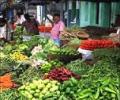
At item level, rice, coconut oil, fish fresh, poultry, milk, onion, vegetables, fruits, sugar, cigarette, electricity charges etc. are responsible for increase in the index.
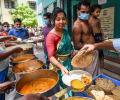
A decision in this regard was taken in the Cabinet meeting chaired by Prime Minister Narendra Modi.
While FMCG companies were not barred from carrying out their operations during the 21-day lockdown, since most manufacture staples and essential products, capacity utilisation remained poor, owing to the restricted movement of raw materials, finished goods, and labour.

The Centre has allocated Rs 73,000 crore to the rural employment guarantee programme Mahatma Gandhi National Rural Employment Guarantee Act for the next fiscal 2021-22, substantially lower than the actual expenditure of Rs 1.11 lakh crore in the current fiscal which included an additional Rs 40,000 crore for the scheme given by the government in the wake of the pandemic's impact on the economy.

While the number of active COVID-19 cases stood at 7,409, as many as 764 people have been cured and discharged, and one had migrated, it said. Of the total 273 deaths, Maharashtra tops the tally with 127 fatalities, followed by Madhya Pradesh at 36, Gujarat at 22 and Delhi at 19.

The NDA govt launched the Mudra scheme to give unsecured loans of up to Rs 10 lakh to small enterprises with the objective to provide self-employment

India is looking at near close to double-digit growth this year and the country will be one of the fastest-growing economies, Finance Minister Nirmala Sitharaman has said. The minister also emphasised that she expects the economic growth next year to be in the range of 7.5-8.5 per cent, which will be sustained for the next decade.

The new cabinet, predictably, has a sizeable number of Yadavs and Muslims, though members of other sections of the society also find a place.

Giving a relief to exporters community, the government on Thursday said it will release Rs 56,027 crore to exporters against pending tax refunds under different incentive schemes for outbound shipments. The amount will be disbursed to more than 45,000 exporters. Briefing the media about the decision, Commerce and Industry Minister Piyush Goyal said that the Rs 56,027 crore, which is being released under various export promotion schemes, is over and above duty remission of Rs 12,454 crore for the Remission of Duties and Taxes on Export Products (RoDTEP) Scheme and Rs 6,946 crore for Rebate of State and Central Levies and Taxes (RoSCTL) Scheme already announced.

Thackeray said he was in constant touch with the Centre over the issue of running more trains to ferry migrant labourers, stranded due to the coronavirus-enforced lockdown, to their native places.

The ministry of home affairs on Wednesday issued a fresh set of guidelines to let migrant workers, students, tourists and pilgrims stranded in different parts of the country to get back home.

Thousands of farmers are protesting on various borders of Delhi since November 26, seeking repeal of three farm laws enacted in September.

The statement comes in the wake of two independent members of the NSC, P C Mohanan and J V Meenakshi, quitting the Commission over disagreements with the government on the back-series GDP data and delay in release of labour force survey. Mohanan was also the acting chairperson of the Commission.

The EPFO pays rate of return to its subscribers on the basis of returns it generates from its investments.

The SOP said priority will be given to compelling cases of in distress, including migrant workers and labourers who have been laid off, short term visa holders faced with expiry of visas, persons with medical emergency/ pregnant women and elderly persons or those required to return to India due to death of family member, and students.
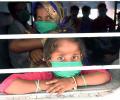
Maharashtra has the most number of coronavirus cases with 23,401 cases.

'There is lack of demand because people have no jobs, and no income.' 'Lakhs of people have lost their jobs and they have no income which has led to no demand in the market.'
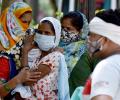
The government on Saturday announced a string of measures, including a pension for dependents of those having lost their lives due to COVID-19, among other benefits for the families who lost their earning members to the pandemic.

While majority of the state governments and union territory administrations have made at least seven days' quarantine compulsory for anyone arriving in their jurisdiction, a few of them have opted for home quarantine for those reaching their administrative limits. According to an official estimate, as on May 26, a total of 22.81 lakh people were in quarantine facilities arranged by different states and union territories -- almost double from 12 days ago (May 14) when the people put under quarantine were 11.95 lakh, a government official told PTI.
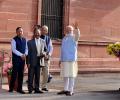
'Modi personally provides the higher direction of the ministry and the minister then works with bureaucrats on implementation,' points out Aakar Patel.
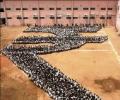
The largest upward contribution to the change in current index came from food group which increased by 1.22 per cent, contributing 1.64 percentage points to the total change. At item level, rice, arhar dal, fish fresh, poultry (chicken), milk, chillies green, garlic, ginger, tomato, root and green vegetables, tea leaf, tea (readymade), cigarette, country liquor prices, electricity charges, medicine (allopathic), and repair charges, are responsible for the rise in index.

The top court said it is not satisfied with the efforts of the Centre as well as the states on the issue of registration of workers in unorganised sectors.
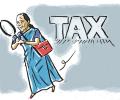
Shalini Gupta, a freelance writer from Pudicherry, tells Rediff.com's A Ganesh Nadar what she would like to see in Finance Minister Nirmala Sitharaman's Budget.

What some of us think are strong, bold and firm decisions are cruel, harsh and unwanted for others. This is what we need to consider when we look at what has happened with the farm laws, asserts Aakar Patel.
